Tuesday, February 19, 2008

A short Berlin trip

A recent visit this week to Berlin yielded some nice panos - so accompany me on a short Berlin trip!

First a look at the very efficient public transportation system in Berlin - since we need to move around a bit on our trip! :-) Here the Suburbun Railway ("S-Bahn") station "Alexanderplatz":


Click here for large version

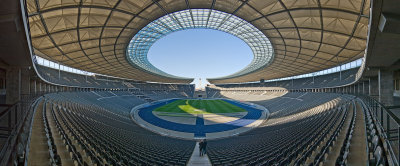
The railway brings us to the Olympic Stadium with its fantastic new ceiling, that hosted the infamous 1936 Olympics, and in younger history the finals of the world soccer championship in 2006:


Click here for large version

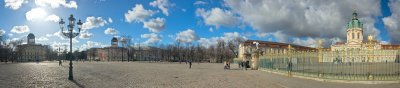
Not far away from the stadium we'll find a castle - "Schloss Charlottenburg". The two similar looking buildings on the left side of the pano, both belonging to the original architectural ensemble of the castle, are the Egyptian Museum (far left) and the Museum Berggruen (middle left), the latter hosting a splendid collection of paintings and sculptures of Picasso, Matisse and Klee:


Click here for large version

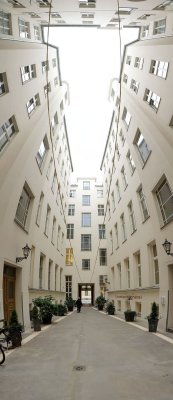
Back in the center of Berlin we'll risk a look into the "Heckmann-Höfe", one of the typical examples of Berlin architecture with inner courts; this one located between Auguststraße and Oranienburger Straße:


Click here for large version

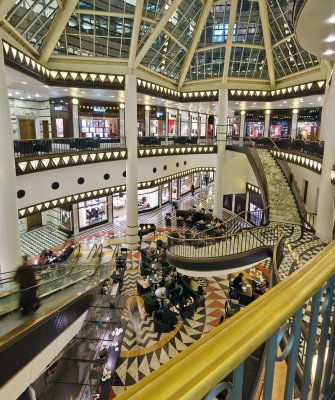
Later in the day it's time for some shopping - so lets visit the Quartier 206, a luxury shopping mall at Friedrichstraße in central Berlin:


Click here for large version

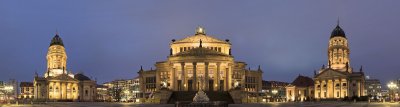
Round the corner of the Quartier 206 we'll find the Gendarmenmarkt - one of the nicest squares in Berlin: on the left you see the "German Cathedral" (now hosting an exhibition about German history), in the middle the "Konzerthaus", a concert hall, and on the right the "French Cathedral", serving nowadays a Huguenot museum:


Click here for large version

Now let's stroll towards the Reichstag for an unusual view of it - together with additional buildings belonging to the administration of the German government, the so called "Bundesband", at a bend of the river Spree.

Here all that seen from a viewpoint near the small Marschall bridge - from left to right in this true 360 degree pano: part of the Marie-Elisabeth-Lüders-Haus; several buildings at the other side of the Spree river; the Reichstag; the Paul-Löbe-Haus; and again on this side the Spree river the Marie-Elisabeth-Lüders-Haus we originally started with: ;-)


Click here for large version

Hope you enjoyed this small tour of Berlin!

Tuesday, January 22, 2008

Romanesco

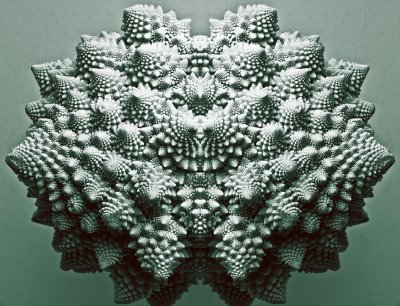
Couldn't resist photographing it before eating it:


Click here for large version

Romanesco is a cauliflower with an interesting similarity to fractals - it's pattern is repeating itself self-similar in different scales. Fascinating, isn't it?

This macro shot was of course mirrored once and stitched together to enhance the mathematical structure of the plant even further. A duplex treatment gave the nice colors.

Tastes less pronounced than broccoli, but has an interesting mild note standard cauliflower hasn't, BTW.

Friday, December 28, 2007

St. Georg fighting the dragon

Click here for large size version

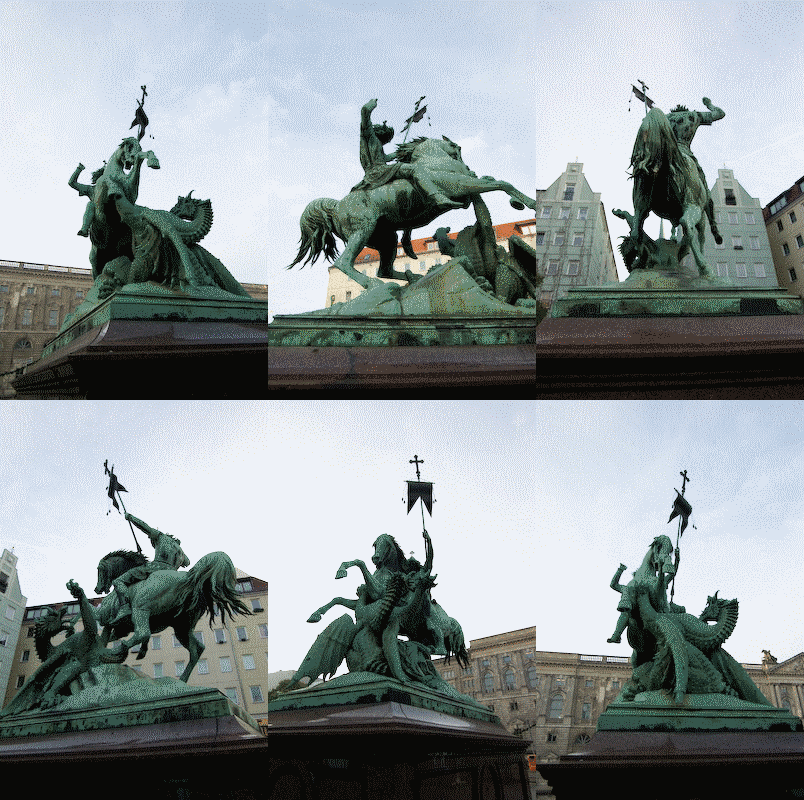
The bronze statue "St. Georg fighting the dragon" was made around 1851-55 and nowadays can be seen in the Nikolai Quarter of Berlin; originally it was located at the Berliner Stadtschloss, which was bombed to ruins in World War II.

The statue depicts in a naturalistic way the brave St. Georg fighting a dragon, retelling thus a rather popular Christian legend. The dragon usually is identified as "The Devil". and St. Georg fights him to release a King's daughter - not to marry her, but to make it possible for her to be christened properly. No wonder that St. Georg, the pure and brave, was one of the most popular Christian saints!

The statue was made by the German sculptor August Kiss (see the inscription at the leftmost part of the pic), whose first famous work also depicted a fight scene, a panther fighting with an Amazon on her horse.

Kiss worked in neo-classical style and very detailed, and since the statue of St. Georg was made near the end of his career and life, it shows his remarkable skills in sculpting an action laden scene like this. A life size plaster version of this statue won August Kiss a bronze medal at the world exhibition in Paris 1855.

The notes for this exhibition in Paris made clear that a the statue needed room - at least 11 meters to all sides were deemed necessary to give the onlooker a good view of it Sadly nowadays the statue resides in a rather cramped space, making it almost impossible to take a good photography of it without introducing too much of the very near and rather high houses in the background - very easy to see here in an animated tour around the statue:


Okay, a challenge is a challenge, and after pondering all possibilities I finally settled for a multi viewpoint / "reverse pano" approach in an attempt to show clearly the fine detail and action depicted so masterfully with this very three dimensional sculpture. ;-)

One last thing: If you wonder why St. Georg fights the dragon with his bare right hand - originally he didn't, he held a sword in this hand, but it got lost over the decades.

So enjoy St. Georg and his gripping fight with the dragon! And get out the popcorn - because this is a looong pic to travel! :-) BTW: If you missed the link directly beneath the small image on top of this post - no need to scroll back, just click here!

Tuesday, November 27, 2007

A special day in Rome

Join me for a special day in Rome! You won't be travelling on a Panorama Bus Cruise, but will be invited to have a glimpse of Rome looking at 17 (!) panorama pictures instead. Have fun!

One note: To really enjoy the tour don't forget to click on the links beneath each panorama picture for the larger versions!

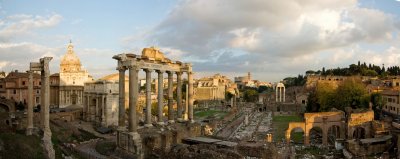
Okay, let's start with the Roman Forum, the "Forum Romanum", a fascinating site of old day Rome at the Capitoline Hill, used as meeting place for commerce and justice as far back as 500 B.C. Here a view of the Forum in the evening light, but since we're starting our day in Rome just imagine it's the morning sun you're seeing here! :-)


Click here for large version.

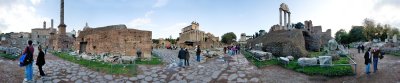
Now let's get down into the Forum for some further exploration of those buildings and artifacts - all of them at least 1400 years old! Here a 360 degree pano taken at "ground level":


Click here for large version.


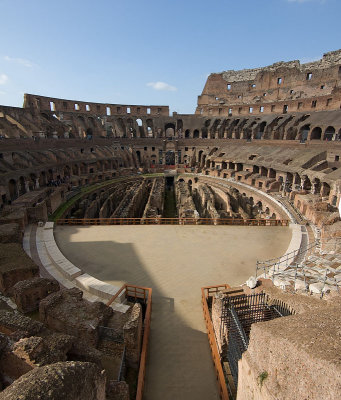
Not far from the Forum the Colosseum can be found, the ancient arena for the entertainement of the masses:


Click
here for large version.


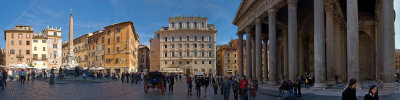
Now let's move slightly forward in time and visit the Piazza della Rotonda, sporting one of the 13 obelisks that can be found in Rome and of course serving as an entrance to the Pantheon (more about that in the next paragraph):


Click
here for large version.


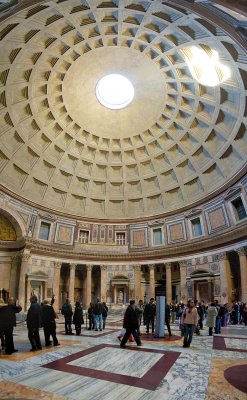
Next stop is the Pantheon, now a Christian church, but originally a building devoted to all deities there are, not only the Christian one. The Pantheon was finished in 125 A.D., and for 1.600 years was the building with the largest dome - 43 meters in diameter - on earth. It hasn't got any windows, only a 9 meter wide "eye" at the top:


Click
here for large version.


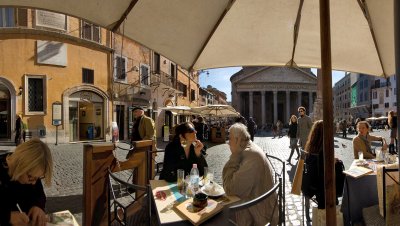
Enough culture for now? Need a rest? Okay, the Piazza della Rotonda is surrounded by nice Italian bars and ristorantes, so let's have a break:


Click
here for large version.


Fit again? Let's move! To St. Peter's Square this time, and without any guards and borders in view you have quickly left Italy and now are standing on the grounds of Vatican City - with another one of those obelisks in sight:


Click here for large version.


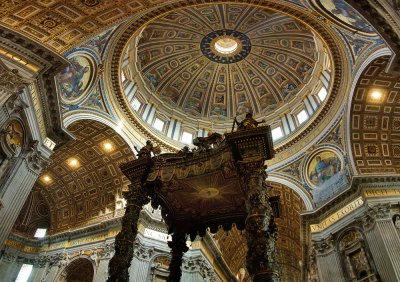
A peek inside St. Peter's Basilica? No problem, it's November and the tourist count is a tiny bit lower than usual, so you can roam the Basilica freely, admiring especially all that colorful marble and gold:


Click
here for large version.


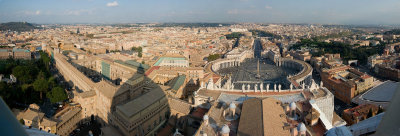
Now it's a question of your fitness - because mounting the more than 500 steps to the top of St. Peter's Basilica is some work. But the reward is a beautiful view towards St. Peter's Square - you can even see Italy (Rome) from here! ;-)


Click here for large version.


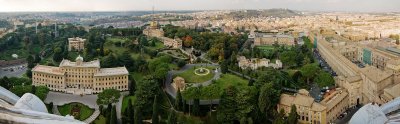
Let's wander a bit to the left to see more of Vatican city, here it's gardens - well, pretty much all of it in fact, save St. Peter's Square and the little railway station - those didn't make it on this picture:


Click
here for large version.


A short look into the Vatican's museum brings us this nice view of the ceiling of the so called "Map Room":


Click
here for large version.


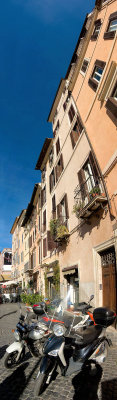
Now for something completely different - let's go to the biggest open air market in Rome on the Campo de' Fiori. It's not that big a market actually, and tourists flood this market especially in the summer time, making lots of noise in the evening and nights and scaring away Roman residents. But now it's November, and things are quiet and peaceful. Here actually not a look at the market, but at one of its sides - with two of the ubiquitous Roman motorcycles decorating some of the typical house fronts lining the market:


Click here for large version.

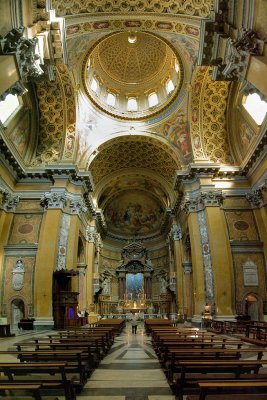
A short way from the Campo de' Fiori we'll find one of the dozens of other fine churches, this time San Carlo ai Catinari, with a voluptuous baroque decoration:


Click
here for large version.


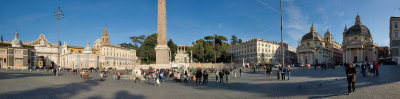
And as an example for another fine square in Rome here a view of the Piazza del Popolo, the entry to Rome from the north of Europe. It has another one of the Obelisks, this one cut off here, but in spite of that one of the oldest - it was brought to Rome in 10 B.C. and orginally had its place at the Circus Maximus. And interesting to note that the "almost twin" churches you can see on the right of the panorama were built (not only) for decoration purposes - they just looked good paired this way:


Click
here for large version.


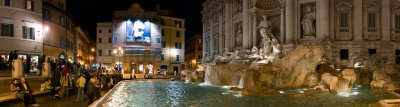
It's getting late, and so it's time for a very special event: Dolce & Gabbana meets the Trevi Fountain! And not Anita Ekberg this time, obviously: ;-)


Click
here for large version.


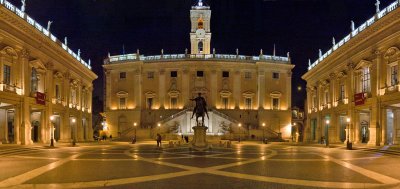
Too much commercials? Okay, let's visit something more officious, the Capitoline Hill with it's main square designed by no one less than Michelangelo (who of course also was responsible for other buildings, places, statues, paintings you'll find all over Rome - see e.g. St. Peter's above):


Click
here for large version.


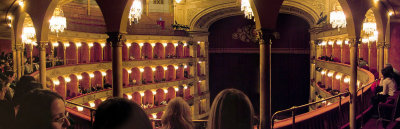
Not tired yet? Than let's go for some classical culture in the Opera house to finish up our nice day in Rome:


Click
here for large version.


Hope you enjoyed the tour! :-)

Want even more pictures & panoramas? Visit the Rome section of my PBase account here!
Sunday, October 7, 2007

"The Mega Multi Maxi Park"

… is what the Duisburg-Nord Country Park in Germany calls itself - and mega, multi and maxi it is! But this is not the usual amusement park you'll find everywhere - this is a truly unique site that combines family fun with industrial history, cultural events and lots of nature at a place where you wouldn't expect it - at an old steel plant.

Between 1901 and 1985 this steel plant in the north of Duisburg - part of the old industrial Ruhr region - operated up to five large blast furnaces. Six years after its closure a competition was held to convert the old steel mill to a public park; the concept of landscape architect Peter Latz won, and the result is quite fascinating: he turned the industrial site into a center of memory and culture, by allowing some old structures and buildings to remain, and by converting some others to new uses: a large gasholder became Europe's largest indoor diving pool; two halls now house theatrical productions, exhibitions and other events; the ore bunkers were partly converted to a multifaceted climbing site. But the stars of the park are the large blast furnaces. You can actually visit and climb on furnace #5 - up to its top, seventy meters high. And what a view you have from it!

View from blast furnace #5 of Duisburg-Nord Country Park - click here for a large size version

But not only these true monuments of old industrial culture and the new use of some of them are awe-inspiring - how nature and plants are allowed to take over other parts of the site is equally impressive. This is demonstrated especially, but not only by the ore bunkers: while some of them now serve - as mentioned - as a climbing site, most of them were left alone, and nowadays small primeval forests grow in them. This not only looks nice, but in fact is an active part in reducing toxic substances that have soiled the surroundings of the steel mill in the years of its active operation. There even is a word for this cleansing process, it's called "phytoremediation".

Here now pictures showing some of the sights offered by the Duisburg-Nord Country Park - a park visited by around 500.000 people each year. Incidentally none of them has to pay a single cent for it, the entrance is free.

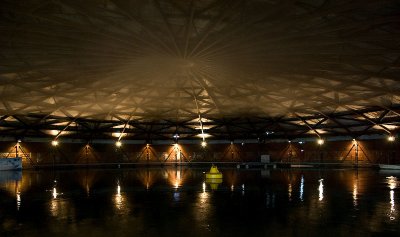
First a look at the diving hall in the former gasholder - this diving site holds 21.000.000 liters of water, and the first flooding of the gasholder took five days. On its ground the divers find pipe systems to explore, also old wrecks - ships, a car, even a small plane:

Click here for a larger version

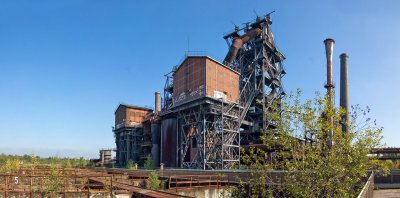
Now a look at the blast furnaces #1 and #2 - on the left the ore bunkers with the plants growing out of them:

Click here for a large version

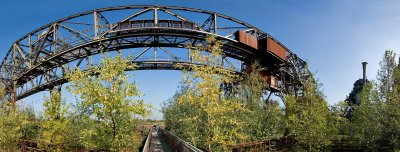
A panoramic and because of that curved look at the large crane used to transport the ore from the bunkers to the furnaces - easy to see how nature already dominates the industrial site here. The crane is nicknamed "The Green Crocodile", because it's illuminated by green lights at some nights:

Click here for a really large version of this panorama

And here a look up the real star of the park, the blast furnace #5 - you can climb it up to its top. This picture is taken among the middle of the furnace, revealing some of the intricate pipe structures of this gigantic edifice:

Click here for a larger version

More images from the park you'll find in my gallery. And lots of information about it here, at its official site.

Saturday, September 29, 2007

Project "Good Weather"

Click here for a larger version - and here for a very large version of this picture!

"This is about difference and sameness. About variety and uniformity. About hunger and satiety. About repetition and change. About culture and tastes. About health and illness. And finally it's about the weather. Because a German proverb says: If you eat everything up properly we'll have good weather!"

That's written on the pic already - and because this blog is about pictures and the stories behind them, here some background.

The picture is designed to be a large poster - the impact is a bit different than here then, and because all the gory detail is there ;-), it can be viewed close up or - stepping back - in its entirety. You're invited to click on the two links below the picture to get a feeling how these different views could be.

It consist of 46 single pictures, taken in August 2008 during my midday work break. The challenge was not to ignore the stares of the onlookers - especially while photographing the "cleaned" plates after eating - but to recreate a look of uniformity. It's incredible how distorted the lenses even of rather capable cameras render straight lines (the pics were taken with a Fuji F810), and how minuscule differences in perspective contort an image. So without a camera mounted on a tripod and consistent studio lighting at hand all one can do is extensive post processing on each and every image to at least create some similarity among them.

But since this image is about sameness and difference, about uniformity and variety, I allowed for slight changes in white balance, lighting, and even went so far to cut off elements at the borders. In a future version of this pic those cut off elements might be eliminated.

All technicalities aside - the bottom line: For me it's a bit like minimal music. Variations, differences, repetitions, rhythms within a tight framework. In other words: Modern civilized life!
Monday, September 10, 2007

Linz and the Ars Electronica

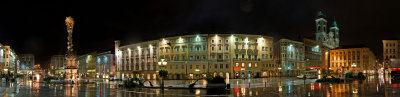
The Hauptplatz in Linz - click here for a large version

Linz: A medium-sized town in the north center of Austria, located on both sides of the Danube. A town with a long history, reaching back to Roman and Celtic settlements. There are aspects of the history of Linz that are quite interesting and nice - e.g. that the city was for a short time in the 15th century capital of the Holy Roman Empire, that the famous mathematician and astronomer Johannes Kepler worked and published in the early 17th century in it (the local university bears his name) and that the composer Anton Bruckner lived and worked here in the 19th century. Very nice to know, sure - but most cities have some famous inhabitants, haven't they?

But Linz is also tied to another, rather infamous person: Adolf Hitler spend a part of his youth there, performed miserably in a local school, but in spite of that somehow grew fond of it (of Linz, not of the school ...). He had big plans for Linz, and - stemming maybe from the feeling of being a unrecognized artist - had the idea to turn it into a cultural center of the Third Reich. And as he proclaimed the annexiation of Austria into Greater Germany in 1938, he did so in Linz, at the townhall at the main square in Linz, the "Hauptplatz". Want to see where? Click on the link beneath the panoramic picture above showing the "Hauptplatz" at night, and look at the somewhat pink building with the small clock tower on the left side on the panorama, right to the large "Plague Column" (built 1717 to remember the victims of the Plague) - this is the townhall.

Curiously enough Hitler's idea to turn Linz into a cultural center somehow worked - fortunately not as he originally planned, but in a much more modern way: Linz nowadays has several fine museums, some of them dedicated to the modern arts, and since 1979 it holds the annual "Ars Electronica", a festival for art, technology and society - a very interesting event, especially nowadays in the times of quickly evolving media technologies.

The panoramic picture above showed you a glimpse of the old Linz - so now some looks at Linz as a modern centre of art & thought!


Interactive video sculpture with bubbles - seen at the Landesgalerie Linz.


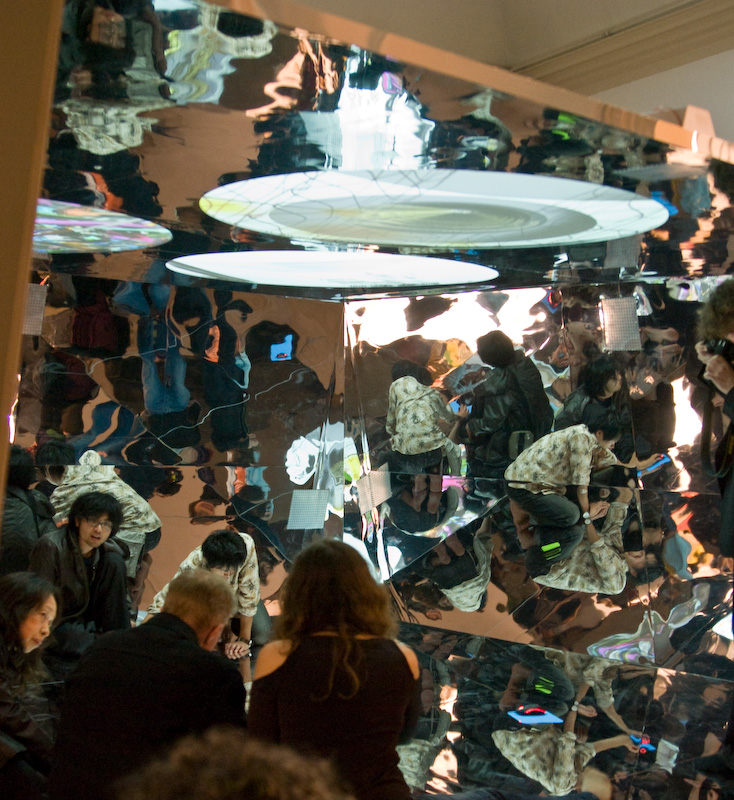
"Mirror cells" - an interactive environment by Sylvia Eckermann and Peter Szely, exhibit at the Ars Electronica 2007. Everybody who wanted could get into that large mirror cell and type some SMS on those projected round screens you see at the ceiling. Altogether quite a sight! So do take your time to sort out all that reflections.


A quick look at this year's conference at the Ars Electronica - main topic was the debate on the value of privacy in the age of blogs like this one. ;-)

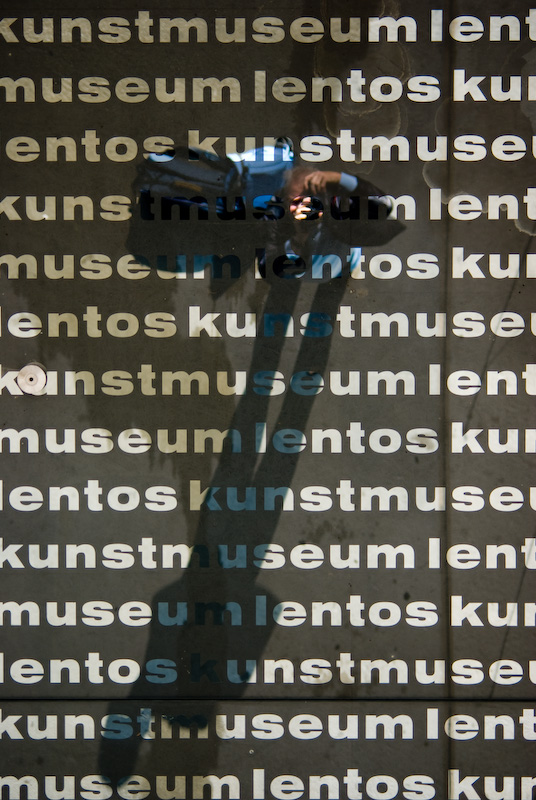
And now as an adequate ending - adequate to the topic of the conference that is - a private look at the author of this lines - reflecting himself in the ceiling of the Lentos art museum in Linz.