Monday, September 8, 2008

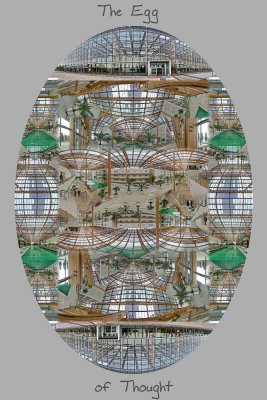
The Egg of Thought

Whoa, what's this?


Click here for large version.


An Egg of Thought, of course, can't you read? ;-)

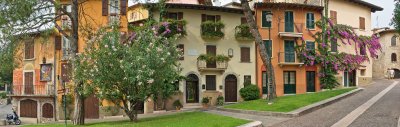
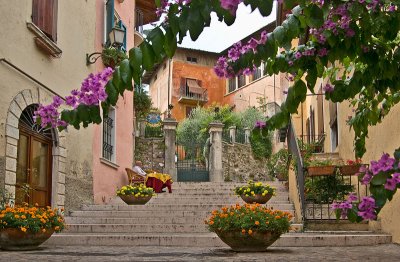
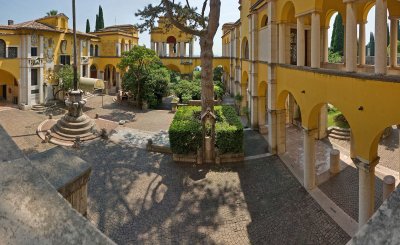
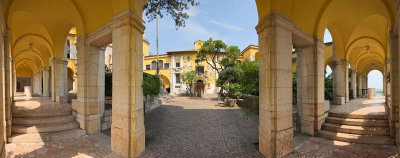
Okay, it really is only an egg-shaped composite made out of panoramas taken inside and outside the Academy of Mont Cenis in Herne, Germany. This academy for vocational education is a magnificent building with a quite extraordinary architecture. Basically it has two long wings: The first contains hotel rooms for the people attending courses for more than one day. The second offers large and small rooms for lectures, workshops, seminars, and in addition to that a reception, a canteen and - for the evenings - a bar.

These two wings are covered by a large "glass box" with a clever computerized air flow system that allows for a "Mediterranean" climate inside the box (the architects claim that the climate of Nice is replicated here) - with only a low amount of energy used. In addition to that the large roof is furnished with a very large number of solar collectors covering 10.000 square meters, reducing the energy intake of the building even further.

Another thing to know is that this academy was built on the location of an old coal mine also called "Mont Cenis". Since we're in the heart of the Ruhr Area this modern academy at the same spot as the old mine sort of symbolizes the economic change this huge area has made - from the coal and steel center of Europe to a center of the modern service society. At least this is what the politicians like to tell ...

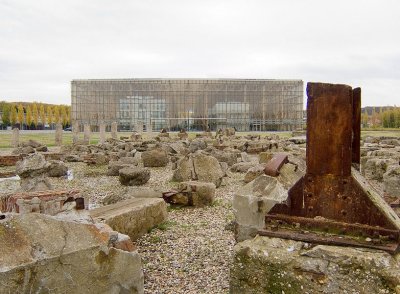
Enough words - now for some pictures; among them some of the panoramic pictures used for the "Egg" you've seen above. This is what the building's glass box looks from its rear end, near some remains of old mine buildings:

Click here for large version.


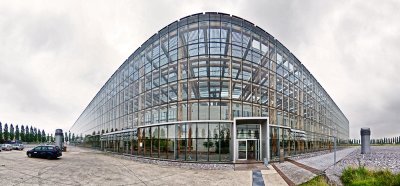
And this is the first panoramic glimpse of the glass box, taken from the side, showing the building and its side entrance:

Click here for large version.


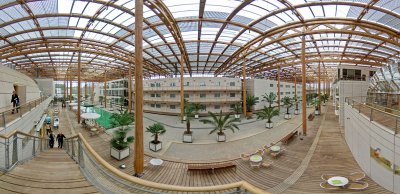
And here we go with the first view of the interior of the building, taken from a balcony at the middle of the "office wing", looking towards the "hotel wing" - you can see part of the canteen on the left side:

Click here for large version.


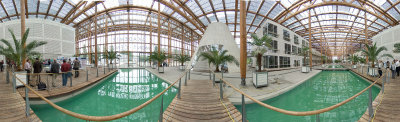
This second interior shot is an 360 degree panorama, taken near the main entrance of the building:

Click here for large version.


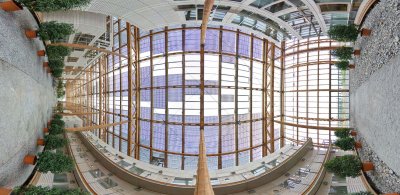
For a change here a another 360 degree view, but now circling from the bottom to the top of the building and back again - taken from another point of view in the rear part of the glass box:

Click here for large version.


Well, I admit that this is not really 360 degrees; the picture is cropped at the left and right sides, because those consisted mainly of grey gravel, adding nothing much to the composition. So we've a field of view of around 270-300 degrees only.

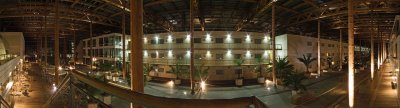
Finally a view somewhat similar to the first interior panorama posted above - of the academy's interior at night:

Click here for large version.


And that's it! Hope you enjoyed this tour of the academy - a true "Egg of Thought"! :-)

Sunday, August 31, 2008

Blue hour in Bardolino

Bardolino is a nice, small town at the Lake of Garda, renowned especially for its popular wines.

It's a quiet, but in the summer quite popular place. Tourists like to stroll in the Old Town of Bardolino in the evening, leisurely walking and looking at the shops in the central, longish Piazza Matteotti that connects to the harbor.

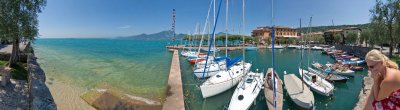
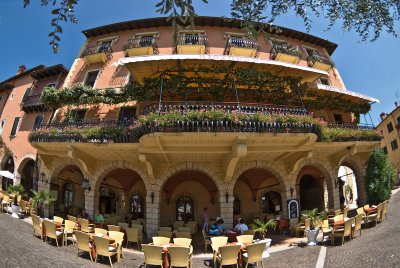
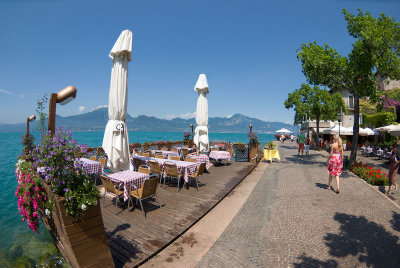
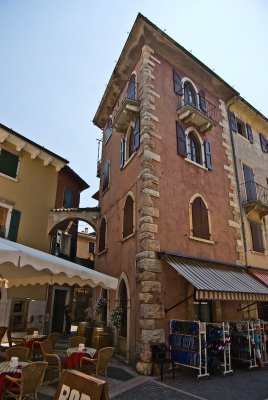
Here some panoramic impressions of Bardolino, mainly of the Piazza Matteotti and the harbor - be careful, some of them are presented in a somewhat unusual fashion, as you will see. Be sure to click on the links below the pictures to see the large size versions of them; sometimes even two sizes are offered. All pictures were taken shortly before or during the "Blue hour", the time between sundown and night.

First a glimpse of the populated Piazza Matteotti with its shops and restaurants:

Click here for large version.


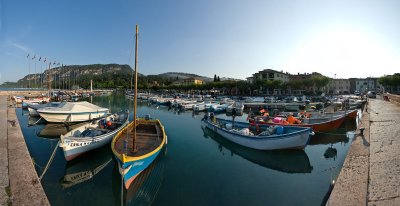
Now a panoramic view of the harbor, depicting it in four different stages of light before and during said "Blue Hour":


Click here for large version.
A very large version you'll find here.


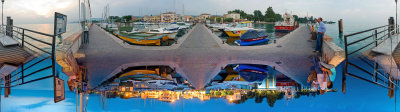
Another way to combine those different stages of light is not to stack them, but to combine them in a single image, as done here with the first and last one seen above:


Click here for large version.


Moving to the back of the harbor here just another possibility to combine day and night scenes of the same panoramic view:


Click here for large version.
An even slightly larger version you'll find here.


And with this last view taken at the close of the Blue Hour - a long time exposure panorama of the harbor from a different point of view - we'll finish our special "Bardolino experience" for now:


Click here for large version.

Tuesday, August 19, 2008

Torri del Benaco

Lake Garda has a lot of nice old towns at its borders, but Torri del Benaco is sure one of the prettiest. It is a rather quiet and picturesque place with a long history, dating back to the Romans. This is reflected by the still impressive remains of the castle, built in 1383, but incorporating old parts of a Roman citadel and a castle from the 10th century that resided at the same spot. This is a 360 degree panoramic view from the highest tower of the castle:


Click here for large version.


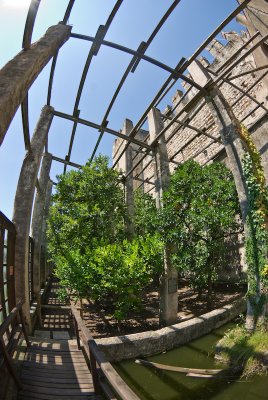
Close to the right to the woman with the red dress you see a wooden construction adjacent to one of the walls of the castle. This is the roof of a "Limonaia", an orchard for growing citrus fruit, that was built in the late 17th century and is still used for that purpose - here a view from below:


Click here for large version.


If the weather turns (too) cold, the wooden "roof" construction will be covered with additional material to protect the fruits.

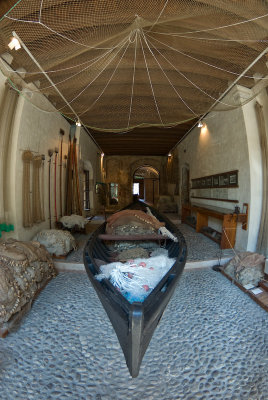
The one remaining edifice of the castle nowadays hosts a small museum devoted to the main trades in Torri del Benaco's history, mainly fishing. Here a look at two exhibits - a fisher boat and its net:


Click here for large version.


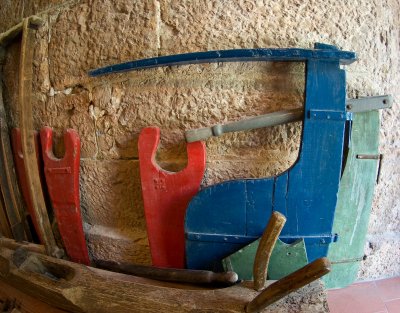
And some colorful old rudders:


Click here for large version.


Directly in front of the castle we find the magnificent harbor of Torri del Benaco, with a grand view of Lake Garda. In the background on the right side you see the Piazza Calderini with the Hotel Gardesana:


Click here for large version.


Here the Hotel Gardesana, a building with a rather long history, in a close up view. At the time the Venetians ruled this part of Lake Garda Torri del Benaco was its capital (sort of ...), and the most important public meetings were held in here, in what is today the dining room of the hotel:


Click here for large version.


On its long promenade running up towards the north Torri del Benaco has a lot of restaurants that offer terraces with beautiful views towards the lake:


Click here for large version.


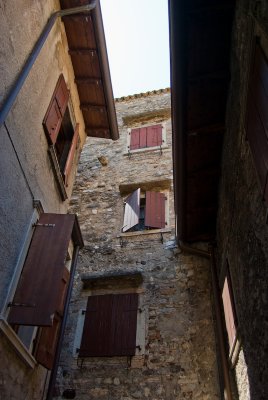
The Old Town offers us nice views of old buildings and small streets, mostly reserved to pedestrians:


Click here for large version.


Click here for large version.


Click here for large version.


In fact Torri del Benaco is - because of its romantic atmosphere - a popular location for weddings; they are held for example at the castle's tower we saw in the first picture.
And there is a quite appropiate legend that says that on the highest tower of the castle once no other than the exiled Romeo stood, looking over the Lake Garda and yearning for his Julia ...

That's it! Hope you enjoyed the tour.

Monday, August 18, 2008

Gardone Riviera - and the Vittoriale degli Italiani

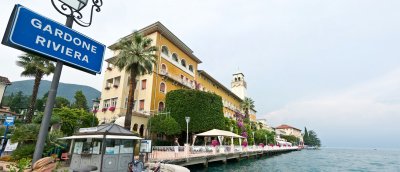
Today we'll visit a town on the east side of the Lake of Garda in Italy - it's called Gardone Riviera, and because of its special environment - the town is enclosed by some small mountain ranges, providing protection from winds and cold - it's famous for its mild climate. That's why one of the first larger hotels of Lake Garda was built here - the Grand Hotel, built in 1884 by the Austrian (then mayor of Gardone) Ludwig Wimmer:


Click here for large version.


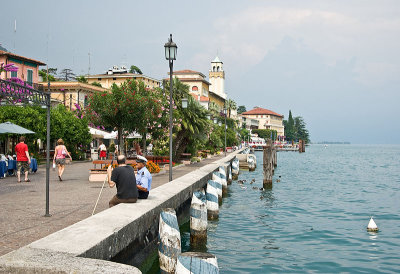
Gardone has a small, but nice promenade - here with the Grand Hotel in the background again:


Click here for large version.


But today Gardones main attraction is not that it is a nice and peaceful health resort - it's famous because one of the most incredible Italian poets chose Gardone as his old-age residence - now serving as a museum called Il Vittoriale. We'll visit it soon - but first have to climb up to the upper part of Gardone, called Gardone Sopra. On our way we find this nice ensemble of houses:


Click here for large version.


And we'll also risk a look at this rather pretty side street:


Click here for large version.


But now we're there - let's enter "Il Vittoriale degli Italiani" - that loosely translates to "Victory memorial of the Italians". It's a very, very strange memorial indeed, mainly one of the poet Gabriele d'Annunzio who lived here from 1921 until his death in 1938.

Why is it strange? Because d'Annunzio, an extremely popular poet & writer, was also a war nut, volunteering to participate in the first world war - he was already 52 years old back then! He did some Kamikaze missions in the first world war, e.g. flew a plane to Vienna to distribute leaflets to the enemy, cruised with a battle ship, and at the end of the war in September 1919 even seized the city of Fiume (nowadays Rieka in Croatia), declared an independent state and governed it in pre-fascistic style until December 1920 - before he retired to his new residence at the Lake of Garda.

At the lake he constructed a quite large complex out of a villa he bought there - after he finished all the work he could look at his own private square, called the "Dalmatian Square". You see his main house, the Prioria, at the left and a loggia at the right:


Click here for large version.


The loggia BTW is a very nice one; here a look standing inside it, looking towards the "Prioria" (center). On the right you see that the loggia is open in direction to the lake:


Click here for large version.


In his Prioria he had a large number of quite dark (he had trouble with his eyesight in old age and shunned light too bright) and immensely richly decorated rooms that show a very special taste - cultures, religions and modern technology clash wildly, e.g. one room was dedicated to death, one to music, one served to receive friends, one to receive enemies, and several were of course used for writing. In the golden and red dining room he had a large sculpture of a tortoise (incorporating its real shell) that died because it ate too much - it served as a reminder to his guests to moderate themselves ...

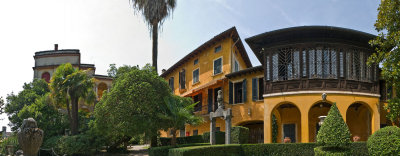
Photography unfortunately was strictly forbidden in the Prioria, so you have to have to be content with this view of the Prioria taken from the private gardens:


Click here for large version.


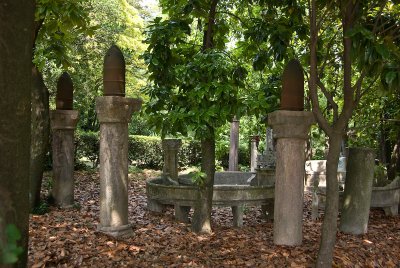
In the private gardens we now discover some strange things typical for d'Annunzio, like these canon shells on classical pillars:


Click here for large version.


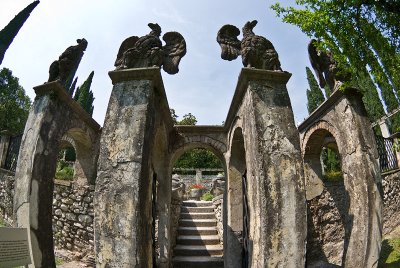
Or this rather incredible combination of eagle sculptures and neo-Romanesque arches:


Click here for large version.


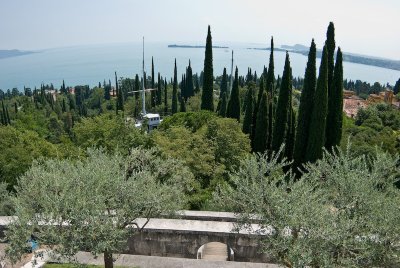
But it gets really strange when we visit the large area around the villa; here a look from the top of a hill: on the right we see the rooftops of the villa, but what's that slightly left of the center? A ship among the trees?!


Click here for large version.


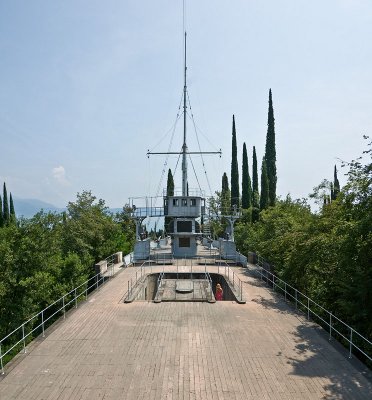
It really is! D'Annunzio requested and got a real large battle ship - called "Puglia" - from the Italian marine, and got it - he planted it in his gardens, looking towards the lake:


Click here for large version.


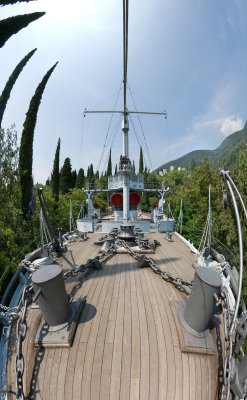
It's fully equipped, as you may see here, taken from the front of it:


Click here for large version.


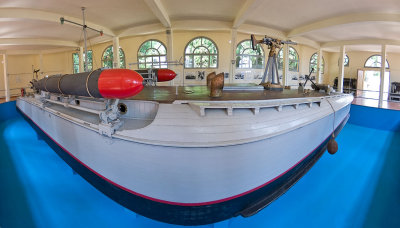
He also requested and got a anti submarine motorboat he had used for one of his other first world war adventures - he used to do fun cruises on the Lake Garda with it, and it's also on display at the Vittoriale:


Click here for large version.


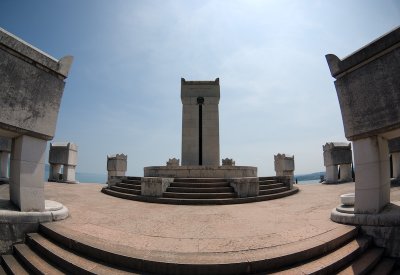
And after his death strange things continued to happen - in the 1950s a large Mausoleum was designed and built, providing a very majestic resting place for the poet, overlooking his "Vittoriale" ...


Click here for large version.


... and of course also with a nice view of the Lake of Garda, as you may see here - the other sarcophagi are reserved for other compatriots BTW:


Click here for large version.


So, that's it from this strange man! I won't dwell on the further political implications of the life and works of d'Annunzio, e.g. his complicated connections to the Italian dictator Mussolini - you can find enough about that on the web.

A few more pics of the Vittoriale - e.g. from the plane he flew with - at my Vittoriale gallery here.

Sunday, August 17, 2008

Sirmione - Pearl of Lake Garda, Italy

A tourist and health resort for more than 2000 years? That sounds interesting - and indeed it is: Sirmione is a very special town at the Lake Garda in Italy, and was a sought after holiday and health location starting even in the first century BC. Main visitors back then were the Romans - coming from Verona, the main Roman city in north-eastern Italy at this time.

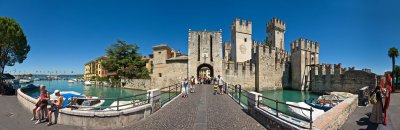
Sirmione is located on a long peninsula located on the southern shore of the lake; the main area is shaped like a triangle, and has only one narrow street leading to it - and this street is guarded by a real menacing castle, the Castello Scaligero, built in the 13th century:


Click here for large version.


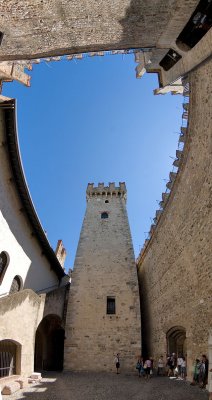
Looking from an inner court we see that this castle is high and intimidating indeed - not built for pleasure, but for fighting:


Click here for large version.


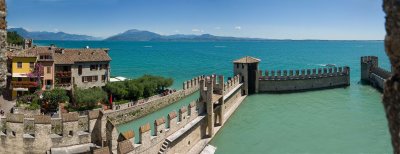
And looking to the western side of the castle towards the lake we see a nowadays quite rare example of a fortified harbor, incorporated into the castle:


Click here for large version.


Finally this view from the castle towards the Old Town of Sirmione is a reminder that the castle not only protected the town - it also served as a means of oppression; a very inglorious incident took place in the late 13th century, as Mastino I. della Scala ordered the ruthless persecution of a religious movement criticizing the holy church - resulting in a true massacre, because half of the inhabitants of Sirmione belonged to this movement. Knowing this the castle suddenly looks only half as romantic - and the castle reaching out to the town people seems to be really menacing:


Click here for large version.


We now wander along the shore of the peninsula until we reach its northern tip - and here, as 2000 years ago, some luxury hotels are located, with their own, very private terraces with a smashing view of the lake:


Click here for large version.


It's simply too hot to visit the Roman ruins in Sirmione today, so we walk back to the Old Town to get some shade - and a view of this nice house on a corner:


Click here for large version.


We now go to the largest Piazza in Sirmione, the Piazza Carducci, surrounded by bars and restaurants - right now even a concert is going on:


Click here for large version.


The Piazza is directly connected to a pier offering another method to reach and leave Sirmione - by ship, on the the eastern side of the peninsula. And with this 370 degree pano (yes!) taken on that pier we finally leave this picturesque and very old town:


Click here for large version.


P.S.: This was the ship I left Sirmione with this day - nice, isn't it?


Click here for large version.

Hope you enjoyed the tour!

Friday, August 15, 2008

Is there fishing in Garda, Italy?

It's an early morning in July, before 6 am. My mission: Find proof if fishing is actually being done in the town of Garda at the Lake Garda in Italy. I'm a bit tired on my way to the harbor of Garda - I must indeed be very tired, because coming into the town I see one of the oldest buildings of the town - the Captain's Palace with its venetian windows - very bended and warped; look at the left:


Click here for large version.


Hmm, once the Captain's Palace stood at the waterfront in Garda. Nowadays tourism seems more important, and the harbor obviously has been relocated to give room for some cafés. Nobody I can ask - but I see the water in the background and will head there:


Click here for large version.


Ah, what a nice early morning view of the lake! And turning to the right I finally see the harbor. Well, well, lot's of nice boats in it! And on the far right I even see the Captain's Palace again. Seems that I have adjusted to the early morning time - it looks straight now, as it should be!

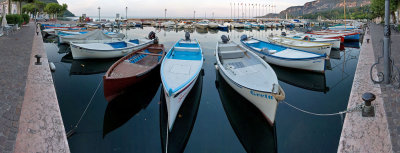
But let's have a closer look at those boats - quite a lot of them here:


Click here for large version.


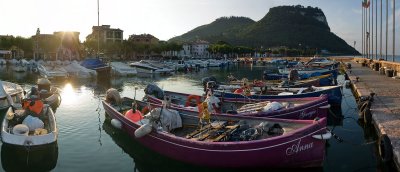
Are any of them really used for fishing? Or are they only here for touristic purposes - as a nice decoration? They look so clean! Let's wander around a bit, and ... yes, in the back of the harbor there are boats that definitely look like being used for fishing. And since the sun is rising now, we even can see more clearly:


Click here for large version.


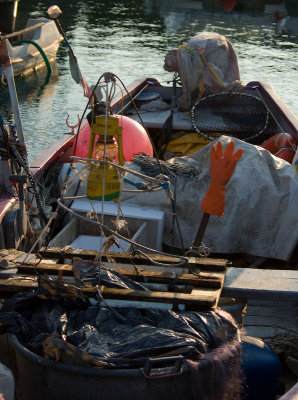
This fishing gear looks really funny sometimes:


Click here for large version.


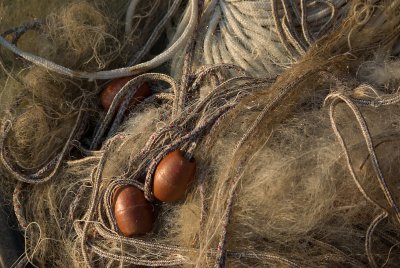
And another indication that fishing really is being done here - all the nets and ropes lying around:


Click here for large version.


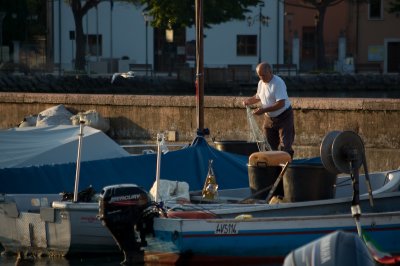
Hey, there's actually someone packing his net - gotcha:


Click here for large version.


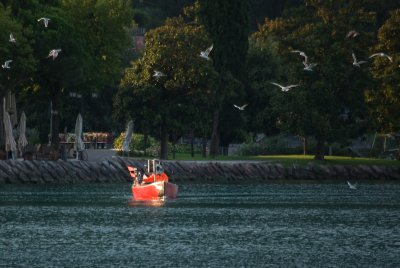
And on the lake there is a boat with a lot of gulls flying nearby - must be somebody fishing:


Click here for large version.


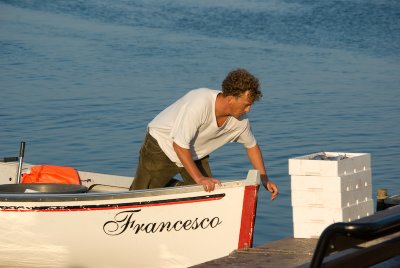
Ah, here the proof: one of the fishers comes in.


Click here for large version.


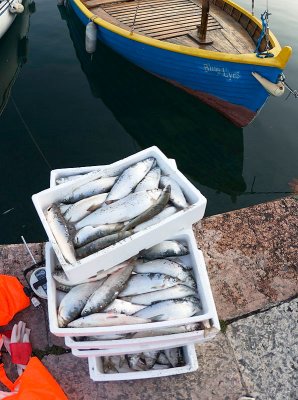
More proof: the early morning catch of another one!


Click here for large version.


Okay, that’s it - I'm convinced that fishing is actually being done here. Now a last view of the harbor, now brightly lit ...


Click here for large version.


... and then back to bed. The fishers are not on vacation obviously, but I am! :-)
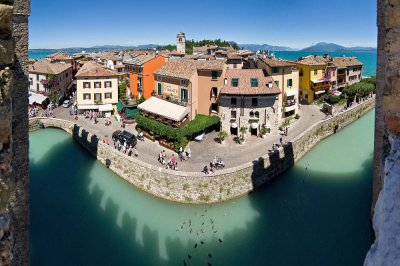
Wednesday, August 6, 2008

Another day in Venice

Welcome to another short tour around Venice in Italy! Be prepared for a lot of panorama pictures – some “normal” shots will also be thrown in when necessary.

Let’s begin our day in Venice – it’s the 24th of July 2008, and the weather is fine - at the Sestiere (Quarter) di Cannaregio, near the central Railway Station St. Lucia. We’ll follow the tourist path to the Rialto bridge a short bit, but at the Canale di Cannaregio we veer off that way to catch a glimpse of the Ponte Guglie:


Click here for large version.


A few “calles” (streets) and turns later we find ourselves at the Campo del Gheto Novo, formerly one of the first Jewish Ghettos in Europe, instituted in 1516 – in fact the name “Ghetto” or “Gheto” is derived from the Venetian expression for iron foundries located formerly at this place, “gheta”. From 1516 on the Venetian Jews were compelled to live in this region of Venice, but at least didn’t have to fear any pogroms or other forms of persecution like in other European cities. So the Jewish population grew, and because of the restricted space the only way to furnish more room for the people was to build additional stories – that’s why the Jewish Ghetto is the only part of Venice where you can find buildings up to seven or eight stories high – look at the left side of this pano:


Click here for large version.


In the center of the pano you can see a white building in the background, right to the red one and partly hidden by a tree – this is the first Synagogue built in the Ghetto, the Scuola Tedesca, built for the German Jews. Very inconspicuous from the outside – the Synagogues were built on top of smaller buildings and so consist of the upper stories of those only - the Scuolas are richly decorated at the inside. The Scuola Italiana can bee seen in the right part of the image – the other white building with the five large windows. On the utmost right of the pano you can see one of the bridges connecting the Gheto Novo with the rest of Venice; in fact this particular bridge leads to the misleadingly named “Gheto Vecchio”, a small complex of streets that enlarged the Ghetto in 1541. Here you can find an eight story building, see here on the right (on the left you can see part of the Scuola Spagnola, another synagogue):


Click here for large version.


We’ll leave the Ghetto now and walk further to the east of Cannaregio. You’ll very soon discover calles and canals almost devoid of any tourists, because you’re very far off the main touristic routes now – for instance this peaceful canal at the Ponte de la Malvasia:


Click here for large version.


Please note the wooden constructions on two of the house on the left side of the pano – these are typical examples of Venetian architecture, called “Altan” or “Altana”, depicting a sort of additional balcony that the Venetians liked (and were allowed) to build on top of their houses.

We now leave Cannaregio, and take the Vaporetto Linea 14 – a sort of water bus – for the following five pics, showing our way along the Canale di Cannaregio …


Click here for large version.


… into the Canal Grande, going beneath the Ponte degli Scalzi and passing the railway station St. Lucia …


Click here for large version.


… veering into the Canale Scomenzera, entering the Sestiere di Dorsoduro and the commercial, less beautiful side of Venice …


Click here for large version.


Click here for large version.


… and finally going along the large Canal della Giudecca …


Click here for large version.


… to alight in the Sestiere di San Marco at the Piazza San Marco to have an obligatory look at the Gondolas moored there, waiting for tourists:


Click here for large version.


There are certainly enough of them there, now that we’ve gotten into the “main lane” again:


Click here for large version.


To escape the masses and to get an overview of things we risk the elevator ride up the Campanile di San Marco, and from there have a beautiful look at the Venetian Lagoon:


Click here for large version.


You can see here from left to right: The South-Eastern part of Venice, East-Castello; the Island of San Giorgo Maggiore directly opposite the Piazza San Marco; the Giudecca - and behind all that - the Lido of Venice.

Following this pano to the right we get a nice view of the Western part of downtown Venice, with the entry of the Canal Grande on the left and part of the Piazza San Marco in the middle:


Click here for large version.


We now leave and walk a short way to the Campo di Santo Stefano, the second largest square in the Sistiere di San Marco, with lots of nicebars and cafés - a beautiful place to rest. In the middle you can seea statue of Nicoló Tommaseo, a popular Italian author in the 19th century. If you look closely you can see a pile of books rising at his back. That’s why Venetians call this statue – a bit unkindly –‘Cagalibri'; this loosely translates to “book-shitter” …


Click here for large version.


We now cross one of the few bridges over the Canal Grande – this time the wooden Ponte dell’ Accademia (see on the right side of the pano) to the Sestiere di Dorsoduro and have a look at this bridge and at some of the fine Palazzi at the Canal:


Click here for large version.


We’ve now entered the quarter of art & higher education of Venice, with lots of museums and different university institutions. Here everything is less crowded, shops are a bit different, atmosphere is more relaxed – like in this café at the Calle Nuva Sant Agnese:


Click here for large version.


We follow our way more or less along the Canal Grande until we almost reach the tip of Dorsoduro at the Campo della Salute – note the Vaporetto station at the left, the Campanile di San Marco visible in the background in the middle right, and of course the Chiesa Santa Maria della Salute on the right:


Click here for large version.


We enter the Chiesa for a short look into its unusual and bright interior; it has an interesting history: In 1630 the Doge of Venice promised to build a church if only the devastating wave of plague would end that robbed Venice a full third of its inhabitants. This was approved by the Senate, who also decreed that every year at the 21st of November the city’s officials should parade from San Marco to this church to commemorate the end of the plague. This is still done each year and involves the building of a special pontoon bridge that temporarily crosses the Canal Grande - for this event only. Now, as promised, the look at the church's interior, very unusually built as a rotunda:


Click here for large version.


We now take another short Vaporetto trip and alight at the Rialto for this view – part of the Rialto market (not far from the famous Rialto bridge) on the right, the Canal Grande with Pallazi and a Vaporetto on the left:


Click here for large version.


A closer look at the Vaporetto reveals many interested tourists looking at the Palazzi:


Click here for large version.


This is a “drive by” pano BTW, multiple pictures taken with a tele lens from the same POV as the Vaporetto passed by. The original has a very high & detailed resolution! :-)
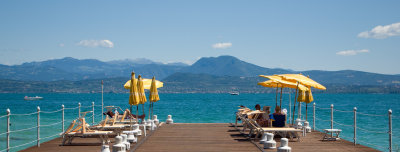
Now our visit nears its end – but not without a look at the spectacular new, yet unnamed bridge crossing the Canal Grande close to the Piazzale Roma (where the standard “street” buses arrive). Occasionally it’s already referred to as Ponte de Calatrava after its award-winning Spanish architect Santiago Calatrava:


Click here for large version.


That close it looks almost organic, like a vertebral column (sort of). Seen from a little distance, here from the Ponte de Santa Chiara, it at least still looks good. And this last pano – a 360 degree one – also shows you the way people have to take if they want to change from bus to railway without the new bridge: They come from the Piazzale Roma behind the building on the right, have to cross the Ponte de Chiara you’re sort of standing on right now, then have to follow the Canal Grande until they reach and cross the Ponte degli Scalzi you can see – if you look very closely – in the far background at the middle right, down the Canal.


Click here for large version.


But who would want to go straight from the bus station to the railway station anyway – just to leave Venice immediately? I wouldn’t! So much to see here – don’t you agree?

Hope you enjoyed the little tour!

More pics of Venice in my gallery – visit it at www.pbase.com/phsan/venezia !