Showing posts with label Germany. Show all posts

Monday, September 8, 2008

The Egg of Thought

Whoa, what's this?


Click here for large version.


An Egg of Thought, of course, can't you read? ;-)

Okay, it really is only an egg-shaped composite made out of panoramas taken inside and outside the Academy of Mont Cenis in Herne, Germany. This academy for vocational education is a magnificent building with a quite extraordinary architecture. Basically it has two long wings: The first contains hotel rooms for the people attending courses for more than one day. The second offers large and small rooms for lectures, workshops, seminars, and in addition to that a reception, a canteen and - for the evenings - a bar.

These two wings are covered by a large "glass box" with a clever computerized air flow system that allows for a "Mediterranean" climate inside the box (the architects claim that the climate of Nice is replicated here) - with only a low amount of energy used. In addition to that the large roof is furnished with a very large number of solar collectors covering 10.000 square meters, reducing the energy intake of the building even further.

Another thing to know is that this academy was built on the location of an old coal mine also called "Mont Cenis". Since we're in the heart of the Ruhr Area this modern academy at the same spot as the old mine sort of symbolizes the economic change this huge area has made - from the coal and steel center of Europe to a center of the modern service society. At least this is what the politicians like to tell ...

Enough words - now for some pictures; among them some of the panoramic pictures used for the "Egg" you've seen above. This is what the building's glass box looks from its rear end, near some remains of old mine buildings:


Click here for large version.


And this is the first panoramic glimpse of the glass box, taken from the side, showing the building and its side entrance:


Click here for large version.


And here we go with the first view of the interior of the building, taken from a balcony at the middle of the "office wing", looking towards the "hotel wing" - you can see part of the canteen on the left side:


Click here for large version.


This second interior shot is an 360 degree panorama, taken near the main entrance of the building:


Click here for large version.


For a change here a another 360 degree view, but now circling from the bottom to the top of the building and back again - taken from another point of view in the rear part of the glass box:


Click here for large version.


Well, I admit that this is not really 360 degrees; the picture is cropped at the left and right sides, because those consisted mainly of grey gravel, adding nothing much to the composition. So we've a field of view of around 270-300 degrees only.

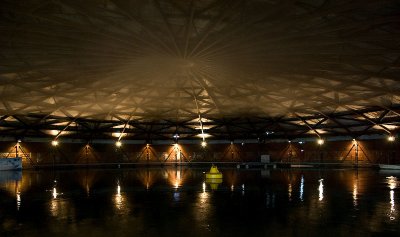
Finally a view somewhat similar to the first interior panorama posted above - of the academy's interior at night:


Click here for large version.


And that's it! Hope you enjoyed this tour of the academy - a true "Egg of Thought"! :-)

Wednesday, April 2, 2008

A medieval tour

Today I'd like to invite you to a tour through medieval Germany - or, to be more precise, a tour showing you remaining old architecture, most times half-timbered houses, in several small cities in the State of Hesse, Germany.

A little background: One jokes that the forefathers of the Hessians, the Germanic tribe of the Chatti, somehow as the only tribe missed the big migration period ("Völkerwandung") in the very early medieval time. Maybe that's why the Hessians are very conscious and proud of their heritage - since they can't be proud of their discoveries and travels! True or not true - at least the Hessians show a lot of effort in caring for their old houses! ;-)

Let's start in the South of Hesse, in the Rhinegau, one of the wine-producing regions along the Rhine. Here we have a glimpse at Eltville, a small and nice town, with a plethora of restaurants offering good food and of course lots of wine, and a nice promenade. Here we see part of this promenade, and on the right side the old castle, originally built in the 14th century. You can see some ruins of it and the restored white tower. The tower was a so called "Wohnturm" BTW, a tower to live in, not one for defending the castle:


Click here for large version.


Now we venture into Eltville's cobblestone streets with a first glimpse of some half-timbered houses and one of the many restaurants, this one called "Yellow House". Unfortunately - you may have noted - this weekend before Easter weather is bad and cold, and no tables wait for the guests outside:


Click here for large version.


With a last look at the Old Town of Eltville - several colorful umbrellas included for free! - we leave this city:


Click here for large version.


Now we'll drive a few kilometers up the Rhine to Johannisberg, risking a look at a vineyard with the Rhine in the background. On the right you see a Romanesque basilica belonging to an old monastery, and this basilica was built in the 12th century to honor John the Baptist - that is how Johannisberg or "John's mountain" came to its name:


Click here for large version.


Venturing up to the North of Hesse we'll now visit Bad Wildungen, a small city and a health resort. It also sports a wonderful Old Town, here some glimpses of it. First the outer region of the Old Town in the evening light:


Click here for large version.


In a side street we discover this blue ensemble:


Click here for large version.


And finally a look at the market square including the Town Hall and a nice pano twin ;-):


Click here for large version.


To the East of Bad Wildungen we find Melsungen, a fascinating town with an Old Town almost completely filled with half-timbered houses. Here a look at the market square with the Town Hall on the right side – the building in red:


Click here for large version.


The sheer number of half-timbered houses you also can see in the side streets of Melsungen inspired me to this somewhat irritating, but at least really self made picture post-card of Melsungen, showing: one of those streets in the background, a sculpture on the left, some half-timbered houses on the market square on top and the Town Hall from 1556 at the right:


Click here for large version.


Last station on our medieval trip is Korbach in the North of Hesse. Here we first see
again a part of the Old Town - on the left with the spire the Town Hall, on the utmost right the public library in the largest half-timbered building of the city:


Click here for large version.


At a side street we discover something rare, a half-timbered house combined with baroque decoration - here it's door:


Click here for large version.


Now something quite corny, a Hotel named "Goldflair" located across the Town Hall, with gold foils in the windows underscoring its name:


Click here for large version.


And with this glimpse of the old market square with a nowadays unused pillory in its center we finish our tour. BTW: The pillory we see here indeed was never used. It was rebuilt in the 1960s for touristic purposes only - but it's modeled after the original that really once stood here - and that one was used for sure! ;-)


Click here for large version.


I hope you enjoyed this travel back in old times - despite the bad weather! And now back to todays world & work!

Sunday, October 7, 2007

"The Mega Multi Maxi Park"

… is what the Duisburg-Nord Country Park in Germany calls itself - and mega, multi and maxi it is! But this is not the usual amusement park you'll find everywhere - this is a truly unique site that combines family fun with industrial history, cultural events and lots of nature at a place where you wouldn't expect it - at an old steel plant.

Between 1901 and 1985 this steel plant in the north of Duisburg - part of the old industrial Ruhr region - operated up to five large blast furnaces. Six years after its closure a competition was held to convert the old steel mill to a public park; the concept of landscape architect Peter Latz won, and the result is quite fascinating: he turned the industrial site into a center of memory and culture, by allowing some old structures and buildings to remain, and by converting some others to new uses: a large gasholder became Europe's largest indoor diving pool; two halls now house theatrical productions, exhibitions and other events; the ore bunkers were partly converted to a multifaceted climbing site. But the stars of the park are the large blast furnaces. You can actually visit and climb on furnace #5 - up to its top, seventy meters high. And what a view you have from it!

View from blast furnace #5 of Duisburg-Nord Country Park - click here for a large size version

But not only these true monuments of old industrial culture and the new use of some of them are awe-inspiring - how nature and plants are allowed to take over other parts of the site is equally impressive. This is demonstrated especially, but not only by the ore bunkers: while some of them now serve - as mentioned - as a climbing site, most of them were left alone, and nowadays small primeval forests grow in them. This not only looks nice, but in fact is an active part in reducing toxic substances that have soiled the surroundings of the steel mill in the years of its active operation. There even is a word for this cleansing process, it's called "phytoremediation".

Here now pictures showing some of the sights offered by the Duisburg-Nord Country Park - a park visited by around 500.000 people each year. Incidentally none of them has to pay a single cent for it, the entrance is free.

First a look at the diving hall in the former gasholder - this diving site holds 21.000.000 liters of water, and the first flooding of the gasholder took five days. On its ground the divers find pipe systems to explore, also old wrecks - ships, a car, even a small plane:

Click here for a larger version

Now a look at the blast furnaces #1 and #2 - on the left the ore bunkers with the plants growing out of them:

Click here for a large version

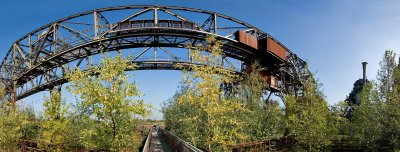
A panoramic and because of that curved look at the large crane used to transport the ore from the bunkers to the furnaces - easy to see how nature already dominates the industrial site here. The crane is nicknamed "The Green Crocodile", because it's illuminated by green lights at some nights:

Click here for a really large version of this panorama

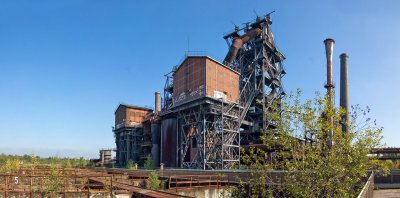
And here a look up the real star of the park, the blast furnace #5 - you can climb it up to its top. This picture is taken among the middle of the furnace, revealing some of the intricate pipe structures of this gigantic edifice:

Click here for a larger version

More images from the park you'll find in my gallery. And lots of information about it here, at its official site.

Wednesday, August 22, 2007

At the "Stuff-and-Cattle-Market"

What is this? A market for "Stuff and Cattle"? It's exactly that, a great yearly market where a lot of things are peddled and traded: cattle like horses and cows, and all sort of small and large stuff - from assorted knives up to expensive front doors, to name only a few examples. All this looks back on some hundred years of history: this year the "Stuff-and-Cattle-Market" in Bad Arolsen, Germany, was held for the 276th time!

Like a lot of yearly markets in Germany it's not only for trading - it's also the time for some fun. And to be honest: most of the around half a million people that visit the market each year go directly to the big funfair part of it - that one with the giant ferris wheel, the cotton candy and shooting booths, and with all those technically advanced amusement rides.

It's open day and night, for three and a half days. Here some glimpses of its attractions - simply click on the pics to see larger versions, especially of the landscape oriented ones:


The specialty of this roller coaster are its spinning cars - the cars not only race up and downward, but also do rotate during the ride. To show a bit more of the action at one glance I took the liberty to combine three single shots for this pic, BTW.


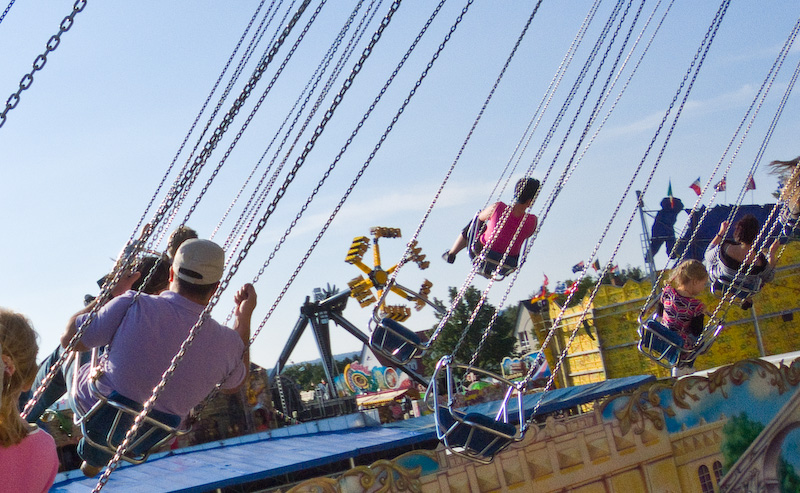
Nice to have a ride on a classical carousel in between. Not that it doesn't twirl with a remarkable velocity when at full speed! I had to hold my camera pretty tight, I can tell you ...


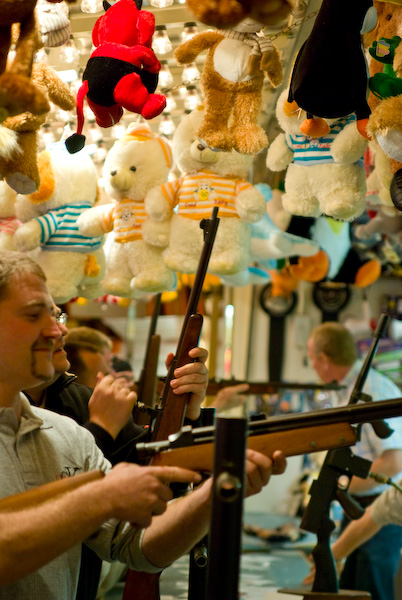
On to the shooting booth, where hard man shoot for cuddly stuffed animals.


A glimpse of the funfair in the evening - the ferris wheel dominating the scene.


Want to have a go at the can-throwing booth? Power and precision is needed here!


Even more power here, for the finale: you're looking at the "Power Tower 2", a free fall ride that reaches a whopping 66 meters in the air - the highest of its kind. The "free fall" you can experience here accelerates up to 54 kilometers per hour downwards. Of course it's completely computer controlled - so no need to fear anything; as long as this controlling computer doesn't run on Windows, of course ;-).

BTW: You're looking at a composite again, this time made out of four (big surprise!) single pics.

More funfair pics at my gallery!

Tuesday, August 7, 2007

Gelato - Italian Icecream

Icecream in Garda, Italy - July 13th, 2007

Gelato - icecream - sure is one of the most fascinating aspects of Italian culture. At least one of the most tasty ones ;-). It comes in a large variety of flavours, and has to be freshly produced and homemade - artigianale - to be considered a worthy dessert for Italians. Here only three of the maybe lesser known compositions available at the better parlors: Ricotta-Fig, Mascarpone-Caramel and Concertina (don't know the ingredients for sure of the latter one, but it's definitely marvelous!).

Like in the pictures shown above and below it's normal style to present the icecream in boxes that are not only full to the brim, but much beyond that. And those mounds of fresh icecream suggest a richness and opulence that's almost impossible to resist. At least once a day you just have to succumb to the temptation and buy some.

But beware: Servings of two different flavours generally are enough for one person, because their size usually is very generous.

In typical tourist areas the icecream shops of course abound, but it's interesting to know while many sources date the beginnings of modern icecream back to the Renaissance in Italy (check here for more information on this) that for a very long time it remained a delicacy reserved for the rich and famous. Only with the invention of freezing machines in the late 19th and early 20th century icecream became easy to produce and affordable for the masses - for us, that is.

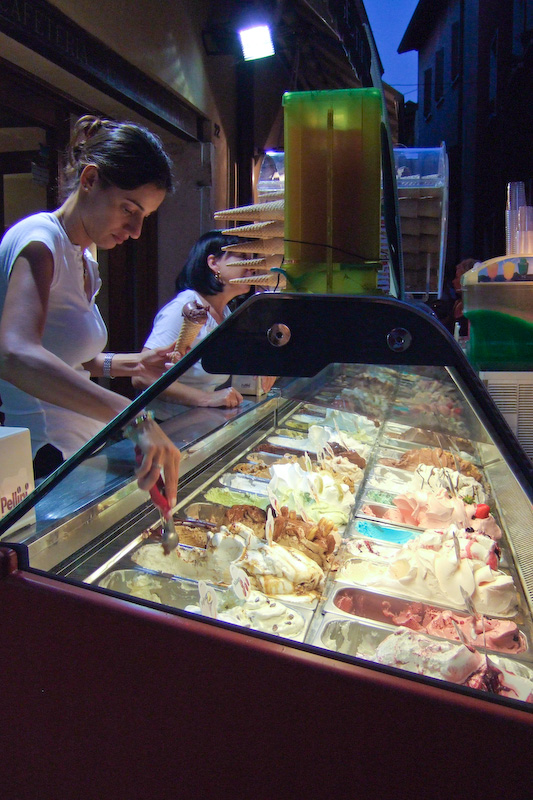
Selling icecream in Lazise, Italy - July 15th, 2007

Another interesting cultural note: Icecream forms a strong bond between Italy and Germany. Italian icecream parlors became popular in Germany beginning with the 1920's, and at that time the Italian immigrants were the first to introduce the delights of international cuisine to the Germans on a broad scale.

Nowadays it's of course normal in Germany - as in every globalized country - to have restaurants offering food from all "four corners" of the world - you'll find e.g. Mexican, Korean, Indian, Thai food easily, and of course much more. But the Italian Icecream parlors named "Venezia", "Dolomiti", "San Marco" - to name only a few typical ones - were the very first to broaden the culinary knowledge and insights of Germans almost a century ago.

Iceream vendor in Lazise, Italy - July 15th, 2007