Tuesday, November 27, 2007

A special day in Rome

Join me for a special day in Rome! You won't be travelling on a Panorama Bus Cruise, but will be invited to have a glimpse of Rome looking at 17 (!) panorama pictures instead. Have fun!

One note: To really enjoy the tour don't forget to click on the links beneath each panorama picture for the larger versions!

Okay, let's start with the Roman Forum, the "Forum Romanum", a fascinating site of old day Rome at the Capitoline Hill, used as meeting place for commerce and justice as far back as 500 B.C. Here a view of the Forum in the evening light, but since we're starting our day in Rome just imagine it's the morning sun you're seeing here! :-)


Click here for large version.

Now let's get down into the Forum for some further exploration of those buildings and artifacts - all of them at least 1400 years old! Here a 360 degree pano taken at "ground level":


Click here for large version.


Not far from the Forum the Colosseum can be found, the ancient arena for the entertainement of the masses:


Click
here for large version.


Now let's move slightly forward in time and visit the Piazza della Rotonda, sporting one of the 13 obelisks that can be found in Rome and of course serving as an entrance to the Pantheon (more about that in the next paragraph):


Click
here for large version.


Next stop is the Pantheon, now a Christian church, but originally a building devoted to all deities there are, not only the Christian one. The Pantheon was finished in 125 A.D., and for 1.600 years was the building with the largest dome - 43 meters in diameter - on earth. It hasn't got any windows, only a 9 meter wide "eye" at the top:


Click
here for large version.


Enough culture for now? Need a rest? Okay, the Piazza della Rotonda is surrounded by nice Italian bars and ristorantes, so let's have a break:


Click
here for large version.


Fit again? Let's move! To St. Peter's Square this time, and without any guards and borders in view you have quickly left Italy and now are standing on the grounds of Vatican City - with another one of those obelisks in sight:


Click here for large version.


A peek inside St. Peter's Basilica? No problem, it's November and the tourist count is a tiny bit lower than usual, so you can roam the Basilica freely, admiring especially all that colorful marble and gold:


Click
here for large version.


Now it's a question of your fitness - because mounting the more than 500 steps to the top of St. Peter's Basilica is some work. But the reward is a beautiful view towards St. Peter's Square - you can even see Italy (Rome) from here! ;-)


Click here for large version.


Let's wander a bit to the left to see more of Vatican city, here it's gardens - well, pretty much all of it in fact, save St. Peter's Square and the little railway station - those didn't make it on this picture:


Click
here for large version.


A short look into the Vatican's museum brings us this nice view of the ceiling of the so called "Map Room":


Click
here for large version.


Now for something completely different - let's go to the biggest open air market in Rome on the Campo de' Fiori. It's not that big a market actually, and tourists flood this market especially in the summer time, making lots of noise in the evening and nights and scaring away Roman residents. But now it's November, and things are quiet and peaceful. Here actually not a look at the market, but at one of its sides - with two of the ubiquitous Roman motorcycles decorating some of the typical house fronts lining the market:


Click here for large version.

A short way from the Campo de' Fiori we'll find one of the dozens of other fine churches, this time San Carlo ai Catinari, with a voluptuous baroque decoration:


Click
here for large version.


And as an example for another fine square in Rome here a view of the Piazza del Popolo, the entry to Rome from the north of Europe. It has another one of the Obelisks, this one cut off here, but in spite of that one of the oldest - it was brought to Rome in 10 B.C. and orginally had its place at the Circus Maximus. And interesting to note that the "almost twin" churches you can see on the right of the panorama were built (not only) for decoration purposes - they just looked good paired this way:


Click
here for large version.


It's getting late, and so it's time for a very special event: Dolce & Gabbana meets the Trevi Fountain! And not Anita Ekberg this time, obviously: ;-)


Click
here for large version.


Too much commercials? Okay, let's visit something more officious, the Capitoline Hill with it's main square designed by no one less than Michelangelo (who of course also was responsible for other buildings, places, statues, paintings you'll find all over Rome - see e.g. St. Peter's above):


Click
here for large version.


Not tired yet? Than let's go for some classical culture in the Opera house to finish up our nice day in Rome:


Click
here for large version.


Hope you enjoyed the tour! :-)

Want even more pictures & panoramas? Visit the Rome section of my PBase account here!

Sunday, October 7, 2007

"The Mega Multi Maxi Park"

… is what the Duisburg-Nord Country Park in Germany calls itself - and mega, multi and maxi it is! But this is not the usual amusement park you'll find everywhere - this is a truly unique site that combines family fun with industrial history, cultural events and lots of nature at a place where you wouldn't expect it - at an old steel plant.

Between 1901 and 1985 this steel plant in the north of Duisburg - part of the old industrial Ruhr region - operated up to five large blast furnaces. Six years after its closure a competition was held to convert the old steel mill to a public park; the concept of landscape architect Peter Latz won, and the result is quite fascinating: he turned the industrial site into a center of memory and culture, by allowing some old structures and buildings to remain, and by converting some others to new uses: a large gasholder became Europe's largest indoor diving pool; two halls now house theatrical productions, exhibitions and other events; the ore bunkers were partly converted to a multifaceted climbing site. But the stars of the park are the large blast furnaces. You can actually visit and climb on furnace #5 - up to its top, seventy meters high. And what a view you have from it!

View from blast furnace #5 of Duisburg-Nord Country Park - click here for a large size version

But not only these true monuments of old industrial culture and the new use of some of them are awe-inspiring - how nature and plants are allowed to take over other parts of the site is equally impressive. This is demonstrated especially, but not only by the ore bunkers: while some of them now serve - as mentioned - as a climbing site, most of them were left alone, and nowadays small primeval forests grow in them. This not only looks nice, but in fact is an active part in reducing toxic substances that have soiled the surroundings of the steel mill in the years of its active operation. There even is a word for this cleansing process, it's called "phytoremediation".

Here now pictures showing some of the sights offered by the Duisburg-Nord Country Park - a park visited by around 500.000 people each year. Incidentally none of them has to pay a single cent for it, the entrance is free.

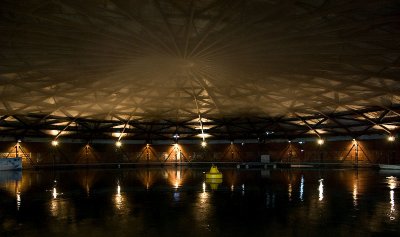
First a look at the diving hall in the former gasholder - this diving site holds 21.000.000 liters of water, and the first flooding of the gasholder took five days. On its ground the divers find pipe systems to explore, also old wrecks - ships, a car, even a small plane:

Click here for a larger version

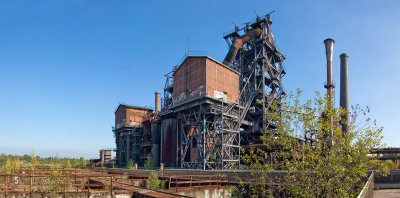
Now a look at the blast furnaces #1 and #2 - on the left the ore bunkers with the plants growing out of them:

Click here for a large version

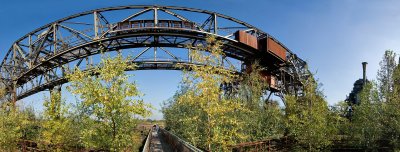
A panoramic and because of that curved look at the large crane used to transport the ore from the bunkers to the furnaces - easy to see how nature already dominates the industrial site here. The crane is nicknamed "The Green Crocodile", because it's illuminated by green lights at some nights:

Click here for a really large version of this panorama

And here a look up the real star of the park, the blast furnace #5 - you can climb it up to its top. This picture is taken among the middle of the furnace, revealing some of the intricate pipe structures of this gigantic edifice:

Click here for a larger version

More images from the park you'll find in my gallery. And lots of information about it here, at its official site.

Saturday, September 29, 2007

Project "Good Weather"

Click here for a larger version - and here for a very large version of this picture!

"This is about difference and sameness. About variety and uniformity. About hunger and satiety. About repetition and change. About culture and tastes. About health and illness. And finally it's about the weather. Because a German proverb says: If you eat everything up properly we'll have good weather!"

That's written on the pic already - and because this blog is about pictures and the stories behind them, here some background.

The picture is designed to be a large poster - the impact is a bit different than here then, and because all the gory detail is there ;-), it can be viewed close up or - stepping back - in its entirety. You're invited to click on the two links below the picture to get a feeling how these different views could be.

It consist of 46 single pictures, taken in August 2008 during my midday work break. The challenge was not to ignore the stares of the onlookers - especially while photographing the "cleaned" plates after eating - but to recreate a look of uniformity. It's incredible how distorted the lenses even of rather capable cameras render straight lines (the pics were taken with a Fuji F810), and how minuscule differences in perspective contort an image. So without a camera mounted on a tripod and consistent studio lighting at hand all one can do is extensive post processing on each and every image to at least create some similarity among them.

But since this image is about sameness and difference, about uniformity and variety, I allowed for slight changes in white balance, lighting, and even went so far to cut off elements at the borders. In a future version of this pic those cut off elements might be eliminated.

All technicalities aside - the bottom line: For me it's a bit like minimal music. Variations, differences, repetitions, rhythms within a tight framework. In other words: Modern civilized life!

Monday, September 10, 2007

Linz and the Ars Electronica

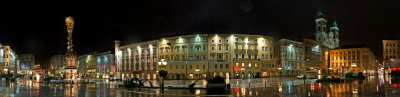
The Hauptplatz in Linz - click here for a large version

Linz: A medium-sized town in the north center of Austria, located on both sides of the Danube. A town with a long history, reaching back to Roman and Celtic settlements. There are aspects of the history of Linz that are quite interesting and nice - e.g. that the city was for a short time in the 15th century capital of the Holy Roman Empire, that the famous mathematician and astronomer Johannes Kepler worked and published in the early 17th century in it (the local university bears his name) and that the composer Anton Bruckner lived and worked here in the 19th century. Very nice to know, sure - but most cities have some famous inhabitants, haven't they?

But Linz is also tied to another, rather infamous person: Adolf Hitler spend a part of his youth there, performed miserably in a local school, but in spite of that somehow grew fond of it (of Linz, not of the school ...). He had big plans for Linz, and - stemming maybe from the feeling of being a unrecognized artist - had the idea to turn it into a cultural center of the Third Reich. And as he proclaimed the annexiation of Austria into Greater Germany in 1938, he did so in Linz, at the townhall at the main square in Linz, the "Hauptplatz". Want to see where? Click on the link beneath the panoramic picture above showing the "Hauptplatz" at night, and look at the somewhat pink building with the small clock tower on the left side on the panorama, right to the large "Plague Column" (built 1717 to remember the victims of the Plague) - this is the townhall.

Curiously enough Hitler's idea to turn Linz into a cultural center somehow worked - fortunately not as he originally planned, but in a much more modern way: Linz nowadays has several fine museums, some of them dedicated to the modern arts, and since 1979 it holds the annual "Ars Electronica", a festival for art, technology and society - a very interesting event, especially nowadays in the times of quickly evolving media technologies.

The panoramic picture above showed you a glimpse of the old Linz - so now some looks at Linz as a modern centre of art & thought!


Interactive video sculpture with bubbles - seen at the Landesgalerie Linz.


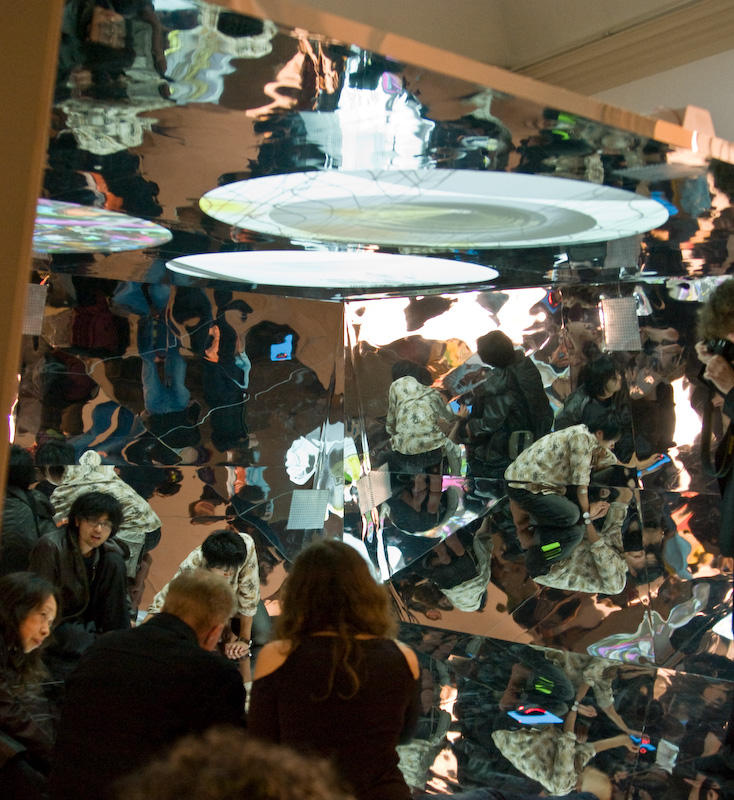
"Mirror cells" - an interactive environment by Sylvia Eckermann and Peter Szely, exhibit at the Ars Electronica 2007. Everybody who wanted could get into that large mirror cell and type some SMS on those projected round screens you see at the ceiling. Altogether quite a sight! So do take your time to sort out all that reflections.


A quick look at this year's conference at the Ars Electronica - main topic was the debate on the value of privacy in the age of blogs like this one. ;-)

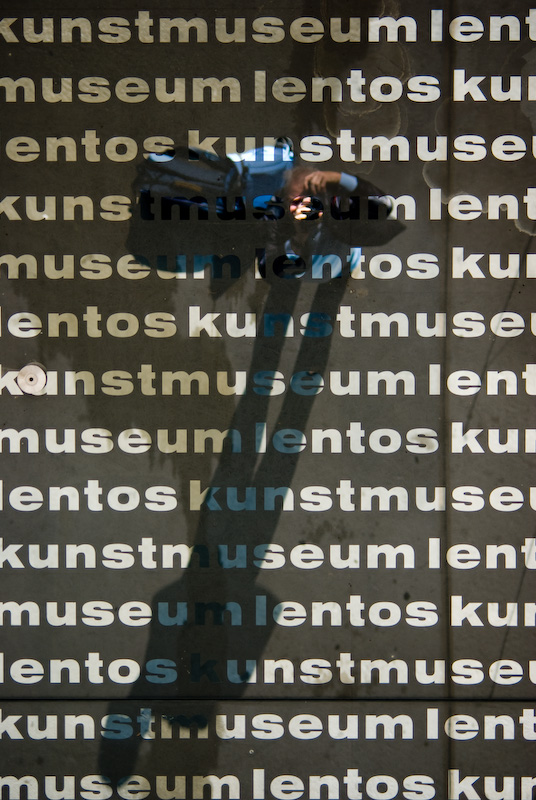
And now as an adequate ending - adequate to the topic of the conference that is - a private look at the author of this lines - reflecting himself in the ceiling of the Lentos art museum in Linz.

Wednesday, August 22, 2007

At the "Stuff-and-Cattle-Market"

What is this? A market for "Stuff and Cattle"? It's exactly that, a great yearly market where a lot of things are peddled and traded: cattle like horses and cows, and all sort of small and large stuff - from assorted knives up to expensive front doors, to name only a few examples. All this looks back on some hundred years of history: this year the "Stuff-and-Cattle-Market" in Bad Arolsen, Germany, was held for the 276th time!

Like a lot of yearly markets in Germany it's not only for trading - it's also the time for some fun. And to be honest: most of the around half a million people that visit the market each year go directly to the big funfair part of it - that one with the giant ferris wheel, the cotton candy and shooting booths, and with all those technically advanced amusement rides.

It's open day and night, for three and a half days. Here some glimpses of its attractions - simply click on the pics to see larger versions, especially of the landscape oriented ones:


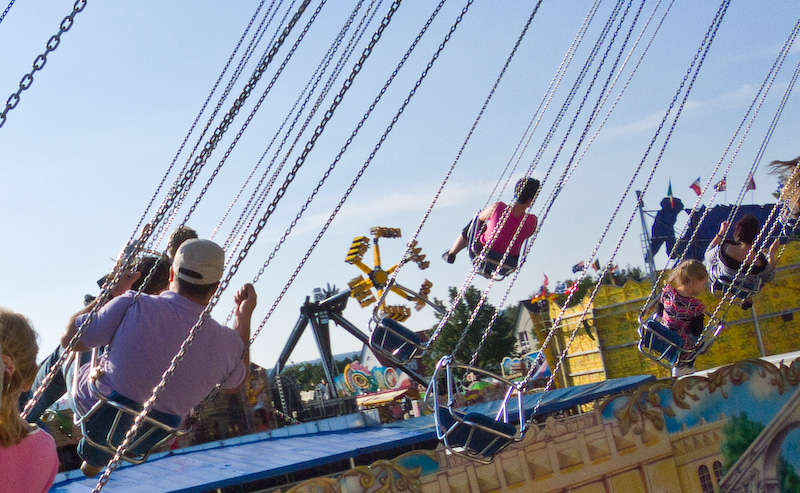
The specialty of this roller coaster are its spinning cars - the cars not only race up and downward, but also do rotate during the ride. To show a bit more of the action at one glance I took the liberty to combine three single shots for this pic, BTW.


Nice to have a ride on a classical carousel in between. Not that it doesn't twirl with a remarkable velocity when at full speed! I had to hold my camera pretty tight, I can tell you ...


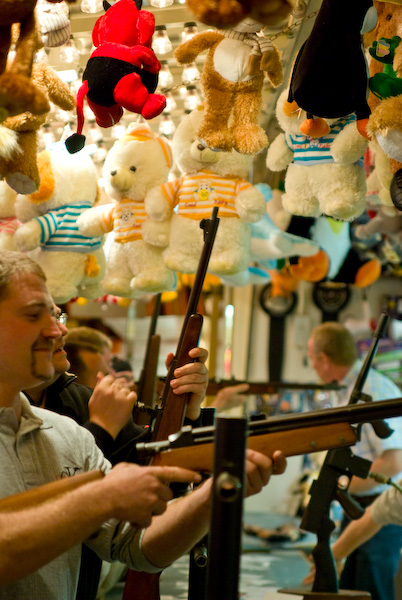
On to the shooting booth, where hard man shoot for cuddly stuffed animals.


A glimpse of the funfair in the evening - the ferris wheel dominating the scene.


Want to have a go at the can-throwing booth? Power and precision is needed here!


Even more power here, for the finale: you're looking at the "Power Tower 2", a free fall ride that reaches a whopping 66 meters in the air - the highest of its kind. The "free fall" you can experience here accelerates up to 54 kilometers per hour downwards. Of course it's completely computer controlled - so no need to fear anything; as long as this controlling computer doesn't run on Windows, of course ;-).

BTW: You're looking at a composite again, this time made out of four (big surprise!) single pics.

More funfair pics at my gallery!

Saturday, August 11, 2007

A panoramic tour of Lake Garda, Italy

Today I want to invite you to a short panoramic tour around Lake Garda in Northern Italy. Six panoramas will offer lots to see! Don't forget to click on the links beneath each picture to get to the full size views.

To get in the right holiday mood lets start with a view of a hotel pool situated a short distance from Peschiera in the south of the Lake Garda - the mountains you can see in the background are those surrounding the lake:

Hotel pool, near Peschiera, Lake Garda - click here for large version

Now let's get down to Peschiera, a small city on the southern side of Lake Garda, situated at the river Mincio, the only river leaving the Lake Garda - all others flow into it. Pescheira has a nice picturesque Old Town - her a view of it in the evening:


Peschiera in the evening - click here for large version


After this relaxing evening we now get on the Gardesena Orientale, the route on the east side of the Lake Garda. Our first stop is Lazise, a small town with a beautiful promenade - grand for nursing a glass of red wine, maybe from nearby Bardolino - and watching the sunset on the lake at the same time. Also worth a look is the old harbour of Lazise:


Lazise harbour - click here for large version

Traveling further north our next stop is Bardolino. Here we visit a sort of "beach" (there are no sand beaches at Lake Garda, only pebble ones) for a swim in the lake. In fact we're a short distance north of Bardolino:

Bathing near Bardolino - click here for large version

Refreshed? Okay, for a very nice evening meal now let's go a few kilometers further north, to Costermano. There you can find a Ristorante named "Miralago" - and that offers a wonderful view of Lake Garda and the city of Garda (named exactly as the lake):

View of Garda from Costermano - click here for large version

Now for a last stop we go around the northern tip of Lake Garda and follow the Gardesena Occidentale, the wonderful route on the west side of the lake. Here the mountains are higher, and the villages at the lake's shore are fewer and due to the steep mountains don't have much space. Until said Gardesena Occidentale was opened in 1931/32 villages like Limone could be reached from the south and eastern shores of Lake Garda by ships only:

Limone - click here for large version

Tuesday, August 7, 2007

Gelato - Italian Icecream

Icecream in Garda, Italy - July 13th, 2007

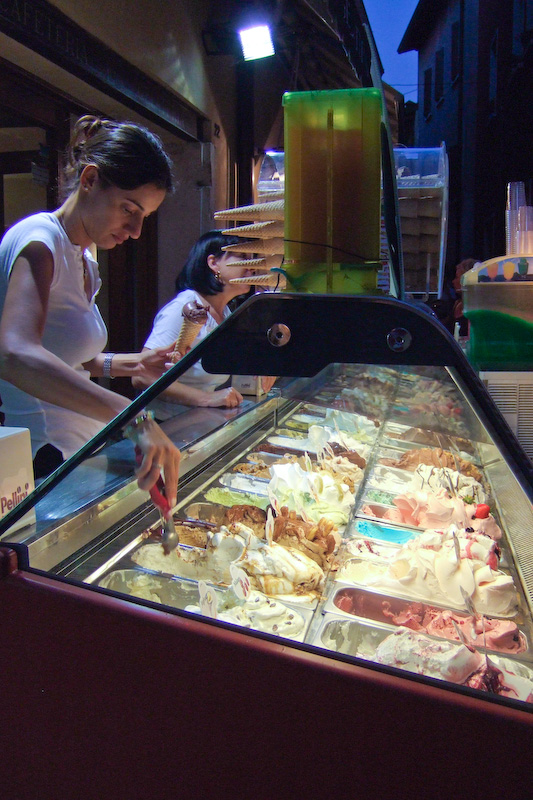
Gelato - icecream - sure is one of the most fascinating aspects of Italian culture. At least one of the most tasty ones ;-). It comes in a large variety of flavours, and has to be freshly produced and homemade - artigianale - to be considered a worthy dessert for Italians. Here only three of the maybe lesser known compositions available at the better parlors: Ricotta-Fig, Mascarpone-Caramel and Concertina (don't know the ingredients for sure of the latter one, but it's definitely marvelous!).

Like in the pictures shown above and below it's normal style to present the icecream in boxes that are not only full to the brim, but much beyond that. And those mounds of fresh icecream suggest a richness and opulence that's almost impossible to resist. At least once a day you just have to succumb to the temptation and buy some.

But beware: Servings of two different flavours generally are enough for one person, because their size usually is very generous.

In typical tourist areas the icecream shops of course abound, but it's interesting to know while many sources date the beginnings of modern icecream back to the Renaissance in Italy (check here for more information on this) that for a very long time it remained a delicacy reserved for the rich and famous. Only with the invention of freezing machines in the late 19th and early 20th century icecream became easy to produce and affordable for the masses - for us, that is.

Selling icecream in Lazise, Italy - July 15th, 2007

Another interesting cultural note: Icecream forms a strong bond between Italy and Germany. Italian icecream parlors became popular in Germany beginning with the 1920's, and at that time the Italian immigrants were the first to introduce the delights of international cuisine to the Germans on a broad scale.

Nowadays it's of course normal in Germany - as in every globalized country - to have restaurants offering food from all "four corners" of the world - you'll find e.g. Mexican, Korean, Indian, Thai food easily, and of course much more. But the Italian Icecream parlors named "Venezia", "Dolomiti", "San Marco" - to name only a few typical ones - were the very first to broaden the culinary knowledge and insights of Germans almost a century ago.

Iceream vendor in Lazise, Italy - July 15th, 2007